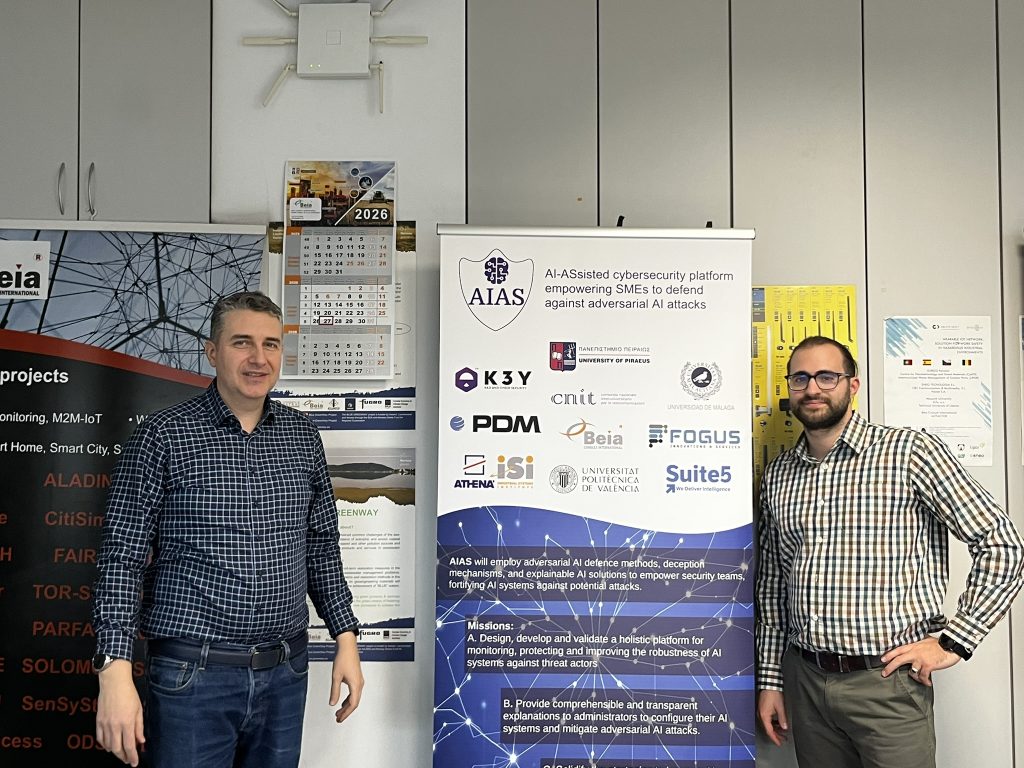
The AIAS project continues to advance its research and innovation objectives through active collaboration and researcher mobility across consortium partners. In this framework, Anastassis Voudouris from UPRC is currently undertaking a one (1) month secondment at BEIA, an SME based in Bucharest, Romania. The secondment commenced on 26 January 2026 and is scheduled to conclude on 25 February 2026.
During this period, Anastassis is actively contributing to key technical activities within the AIAS project, particularly under Work Package 3 (WP3) and Work Package 4 (WP4). His work focuses on the design and implementation of critical components that support both the offensive and defensive dimensions of adversarial AI research, which are central to the AIAS vision of strengthening AI system security.
A major focus of the secondment is the design and delivery of the AIAS weaponizer component. This module is responsible for executing controlled adversarial AI attacks against target models and systems, enabling the platform to simulate realistic threat scenarios. The development of this capability is essential for evaluating the resilience of AI models and validating the effectiveness of defensive countermeasures developed within the project. By enabling systematic adversarial testing, the weaponizer contributes to the creation of a robust adversarial evaluation pipeline within the AIAS ecosystem.
In parallel, Anastassis is contributing to the design of AIAS’s security data fusion and knowledge base components. These elements play a crucial role in aggregating, correlating, and contextualizing security-relevant data collected from multiple AIAS modules and external sources. The goal is to enable advanced threat intelligence capabilities, support explainable decision-making, and enhance the platform’s ability to detect and respond to complex adversarial behaviours targeting AI-driven systems.
Another important activity during the secondment involves the development of a dedicated detection module for adversarial AI attacks. This module is being designed to operate across multiple neural network paradigms, including Artificial Neural Networks (ANN), Convolutional Neural Networks (CNN), and Recurrent Neural Networks (RNN). By supporting multiple model architectures, the module aims to provide broad applicability across diverse AI deployment scenarios, including computer vision, time-series analysis, and sequential data processing environments. The detection capabilities are expected to combine behavioural analysis, anomaly detection, and model-response monitoring techniques to identify potential adversarial manipulation attempts.
Beyond the technical outcomes, the secondment is strengthening collaboration between UPRC and BEIA teams, facilitating knowledge transfer, aligning development methodologies, and accelerating integration efforts across AIAS modules. Such cross-organizational collaboration remains a cornerstone of the AIAS project, ensuring that research outputs are both scientifically rigorous and practically applicable.
Through initiatives such as this secondment, AIAS continues to reinforce its commitment to advancing secure, trustworthy, and resilient AI technologies, addressing emerging cybersecurity challenges in increasingly AI-driven operational environments.