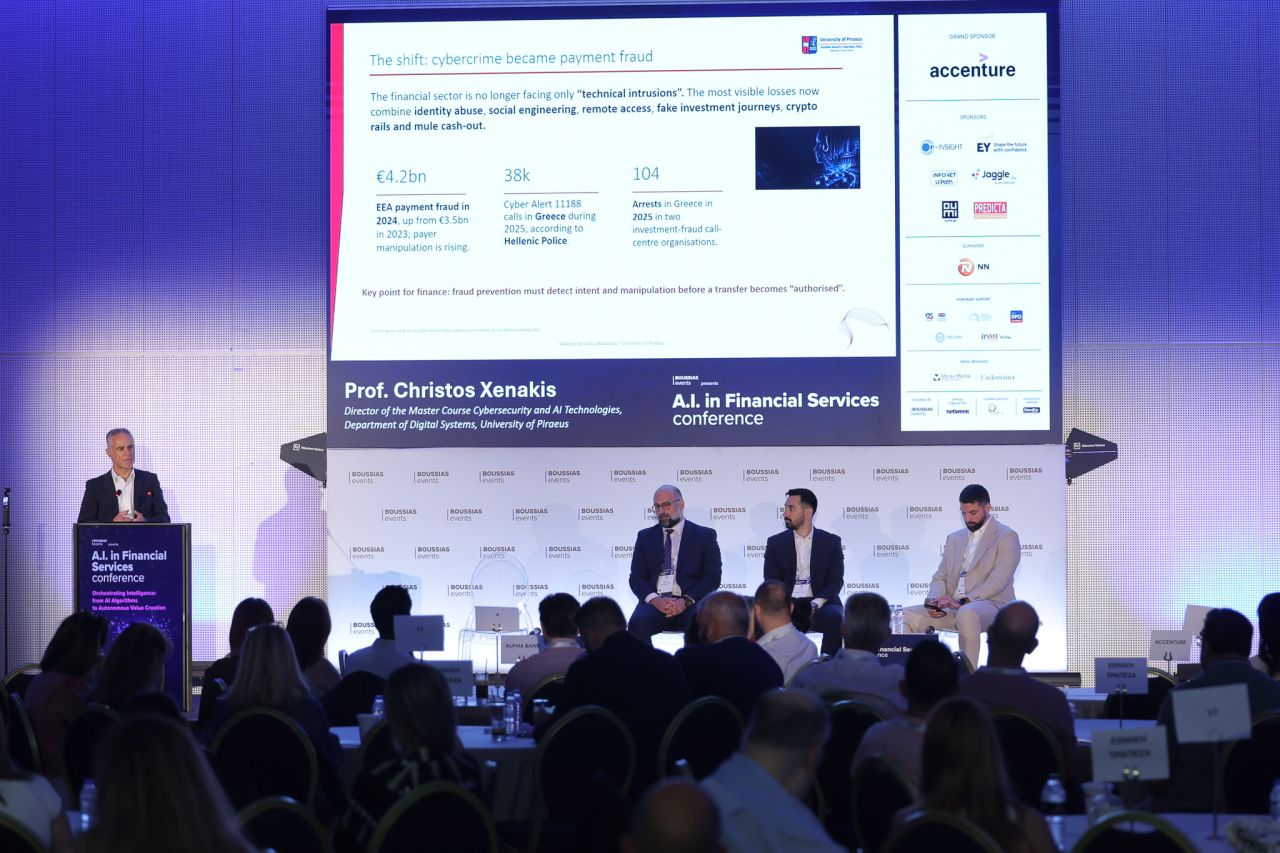
On 8 July 2026, Prof. Christos Xenakis, Professor at the University of Piraeus and Coordinator of the AIAS MSCA project, participated in the 2nd AI in Financial Services Conference 2026, organised by BOUSSIAS, contributing with an academic keynote address and a multidisciplinary panel discussion on the rapidly evolving cybersecurity challenges facing the financial sector.
From Phishing to Deepfakes: AI-Driven Identity Threats
In his keynote, entitled “From Phishing to Deepfakes: AI-Driven Identity Threats in Financial Services,” Prof. Xenakis examined how Artificial Intelligence is reshaping established forms of cybercrime. Rather than replacing traditional attacks, AI increasingly enhances their realism, scalability and effectiveness, removing many of the warning signs that previously helped users and organisations identify malicious activity.
The presentation highlighted the convergence of phishing, smishing, vishing, voice and video cloning, deepfake impersonation, digital identity abuse and remote-access scams into an increasingly coordinated fraud ecosystem. In this environment, attackers may no longer need to directly bypass technical security controls; instead, they can manipulate legitimate users into authorising fraudulent actions themselves.
A key message of the presentation was that credentials, passwords and successful multi-factor authentication alone are no longer sufficient indicators of trust. Financial institutions increasingly need mechanisms capable of evaluating the broader context and intent of a transaction in real time, considering the complete behavioural and operational “story” surrounding it rather than relying solely on successful authentication.
Multidisciplinary Discussion on AI, Identity and Cybersecurity
Prof. Xenakis also participated in a panel discussion together with Vaios Bolgouras, Postdoctoral Researcher at the University of Piraeus Research Centre; Aristeidis Farao, Senior Cybersecurity Engineer at InQbit Innovations; and Apostolos Koutsoulelos, Attorney-at-Law at K. Koutsoulelos Law Office.
The discussion addressed several emerging challenges at the intersection of Artificial Intelligence, cybersecurity, digital identity and financial regulation, including agentic AI and prompt injection, real-time identity verification in the presence of deepfakes, the practical deployment of Zero Trust architectures and Privileged Access Management, and the relationship between cybersecurity controls and regulatory frameworks such as DORA, PSD2 and NIS2.
Particular attention was also given to the growing role of defensive AI, as well as to the continuing importance of human awareness and organisational preparedness as components of a multilayered security strategy.
Connecting European Research with Real-World Security Challenges
The scientific perspective presented during the conference draws upon research results and expertise developed through European initiatives including AIAS MSCA, ANTIDOTE MSCA and the cPAID Project.
These projects contribute to advancing the understanding of threats affecting AI-enabled systems and to developing approaches for secure, resilient and trustworthy Artificial Intelligence. Their research is particularly relevant as AI becomes increasingly integrated into critical services and decision-making environments, including financial infrastructures where identity, authentication and transaction integrity are fundamental security requirements.
The conference provided an important opportunity to connect ongoing academic and European research with the operational, regulatory and societal challenges currently faced by the financial sector.
As AI-enabled threats continue to evolve, protecting financial services will increasingly require cybersecurity technologies, regulatory compliance, cross-sector collaboration and human judgement to operate as a unified security ecosystem.
We thank BOUSSIAS and the organising team for the invitation and excellent organisation, as well as all panellists and participants for the insightful discussion and exchange of perspectives.
Related links: Christos Xenakis – LinkedIn